
How Many Watts Does a Vacuum Use?
You’ll find vacuum wattage varies widely based on the type and cleaning power you need. Handheld models use 200 to 600 watts, perfect for quick cleanups.
Stick vacuums consume 350 to 800 watts, balancing portability and power.
Upright and cylinder vacuums require 1200 to 2000 watts for deep cleaning large areas.
Industrial vacuums can use up to 3000 watts for heavy-duty tasks.
Understanding wattage helps you choose the right balance between performance and energy use.
There’s more to discover about how wattage affects efficiency and costs.
So, knowing how many watts a vacuum uses can really help you pick the best one for your needs without wasting energy or money.
Key Takeaways
- Vacuum wattage varies by type, ranging from 200 watts for handhelds to 3000 watts for industrial models.
- Handheld vacuums typically use 200–600 watts. They’re ideal for light and quick cleaning tasks.
- Stick vacuums consume 350–800 watts, balancing portability with moderate cleaning power.
- Upright and cylinder vacuums require 1200–2000 watts for deep cleaning larger areas.
- Higher wattage increases energy use but doesn’t always improve suction or cleaning efficiency. So, more watts doesn’t necessarily mean better cleaning.
What Are Typical Wattage Ranges for Different Vacuum Types?
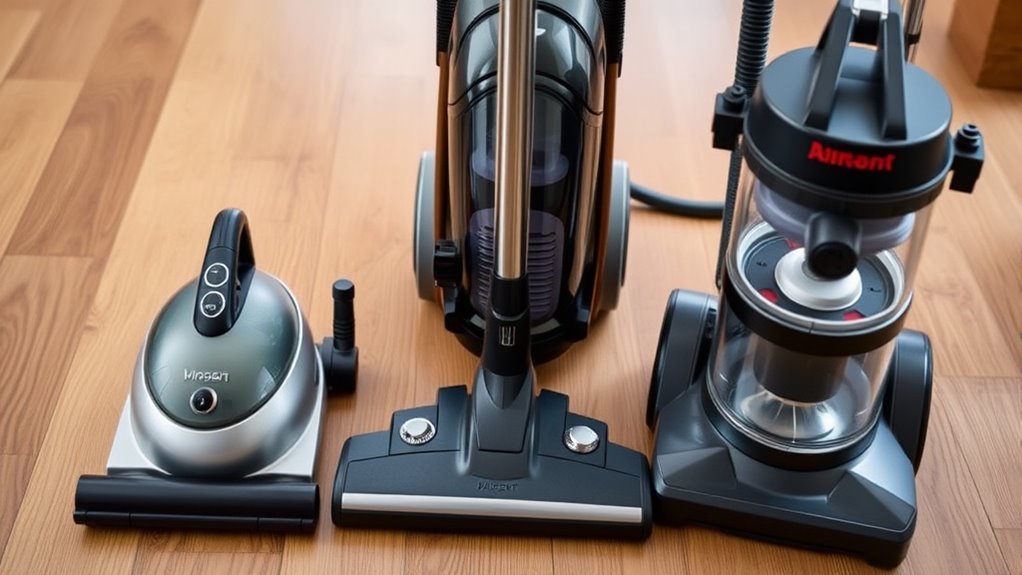
While wattage can vary, handheld vacuums typically use between 200 and 600 watts, making them suitable for quick, light cleaning. When you look at typical wattage ranges across vacuum types, stick vacuums usually consume between 350 and 800 watts, balancing portability and power output.
Upright and cylinder vacuums demand more motor power, drawing roughly 1200 to 2000 watts to handle larger areas and deeper cleaning. If you’re considering industrial vacuums, expect power outputs up to 3000 watts, designed for heavy-duty tasks with high energy consumption.
Understanding vacuum wattage helps you choose the right model based on your cleaning needs and energy use preferences. Each vacuum type’s motor power directly affects its performance and how much energy it requires.
How Does Vacuum Wattage Impact Cleaning Performance and Energy Costs?
Although higher wattage vacuums often draw more energy, they don’t always clean better because suction depends on factors like airflow and design. Vacuum wattage alone doesn’t guarantee superior cleaning performance.
Suction power, measured in air watts, better reflects cleaning effectiveness. High wattage can raise energy costs without considerably improving dirt removal.
Energy-efficient models optimize motor design and airflow to deliver strong suction with lower power consumption. This way, they balance cleaning effectiveness and energy savings.
| Wattage Impact | Cleaning & Energy Insights |
|---|---|
| High Wattage | More power consumption; marginal cleaning gains |
| Low Wattage | Lower energy costs; effective with good design |
| Energy-Efficient Models | Balanced suction power and reduced energy costs |
Frequently Asked Questions
Is 500 Watts Good for a Vacuum Cleaner?
Yes, 500 watts is good for light cleaning and small spaces. You’ll get enough power for hard floors and low-pile carpets.
But if you need deep cleaning, consider a vacuum with higher wattage. That way, you’ll have the extra power to tackle tougher dirt and debris.
Is 700W Enough for a Vacuum Cleaner?
You’ve got a solid steed in a 700W vacuum—it’s enough for most homes, tackling hard floors and light carpets with ease.
Just remember, good design and upkeep make it punch way above its weight.
How Many Watts Should a Good Vacuum Cleaner Have?
You should look for a vacuum with 800 to 1500 watts for solid cleaning power. It balances energy use and performance, so your vacuum handles most tasks effectively without wasting electricity or struggling on tougher messes.
That range really hits the sweet spot. You get enough power to clean well, but it won’t be a huge energy hog. Plus, it’s versatile enough for everyday messes and those more stubborn spots.
Does a Vacuum Use a Lot of Electricity?
You’ll hear a vacuum hum and feel its power, but it doesn’t gulp electricity like a furnace. It uses moderate watts, so running it a little won’t spike your bill.
Just keep it efficient and maintained. That way, it works well without wasting energy.
Conclusion
Think of a vacuum’s wattage like a car’s horsepower—it tells you how much power it has under the hood. Just as a sports car uses more fuel but goes faster, a high-watt vacuum cleans tougher messes but uses more energy.
When I switched to a 900-watt model, my carpets looked spotless, and my energy bill barely budged. It was a win-win! So, choosing the right wattage means balancing power and cost for your cleaning ride.
In the end, understanding how many watts a vacuum uses helps you pick the perfect machine for your needs. Whether you want deep cleaning power or energy efficiency, knowing the wattage guides smart choices. After all, a vacuum’s wattage directly affects both cleaning performance and electricity consumption, making it a key factor in your home’s upkeep.


