How Loud Is a Vacuum Cleaner – A Noise Level Guide
You’ll find most vacuum cleaners produce noise between 60 and 80 decibels, which is about as loud as a normal conversation or busy city traffic. This range is pretty common for many household vacuums, so it’s helpful to know what to expect when shopping for one.
Quieter models, including robot vacuums, often hum around 55-65 dB. That’s closer to the noise level of a refrigerator running or soft office background sounds. These quieter options can make cleaning less disruptive, especially if you live in an apartment or have small kids or pets.
The main noise comes from the motor and airflow, while brush rolls add extra sound when used on hard floors. If you want to understand what affects vacuum noise and explore quieter options, there’s more to discover about their design and components.
It’s worth knowing this to pick a vacuum cleaner that fits your noise comfort level.
Key Takeaways
- Vacuum cleaners typically produce noise levels between 60 and 80 decibels. That’s about the same as a normal conversation or city traffic.
- Quiet vacuum models emit around 55-65 decibels, which is comparable to the hum of a refrigerator.
- Motor noise and airflow design are the main factors that influence how loud a vacuum gets.
- Also, brush rolls and worn components can make things noisier, especially when you’re cleaning hard floors.
- To keep things quieter, sound insulation and mufflers are used. They help reduce motor noise and make the vacuum more pleasant to use.
How Loud Is a Vacuum Cleaner Compared to Everyday Sounds?
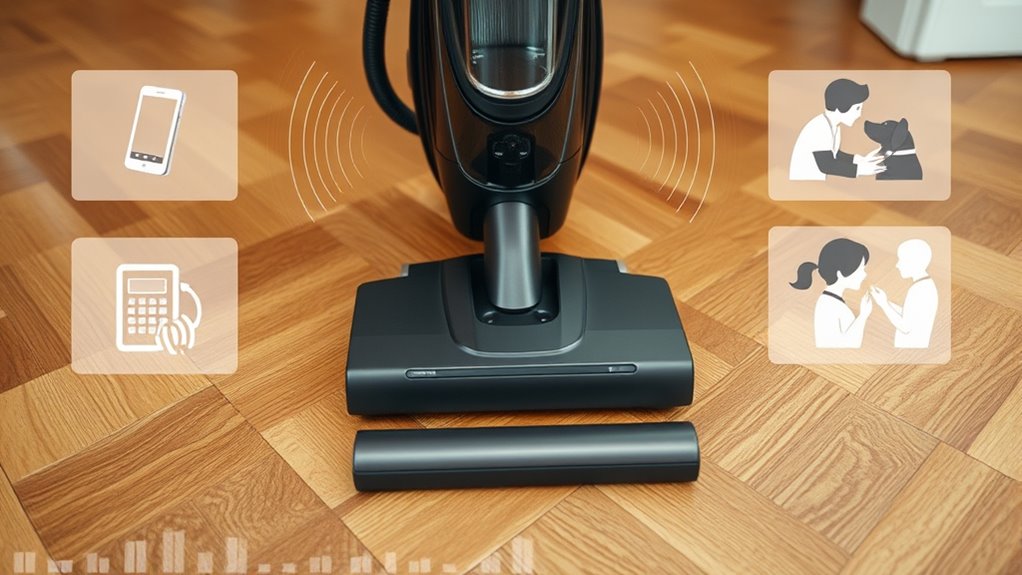
How loud is a vacuum cleaner compared to sounds you hear every day? Typical vacuum noise ranges between 60 and 80 decibels, placing it within the spectrum of common everyday sounds.
Vacuum cleaners typically produce noise levels between 60 and 80 decibels, similar to everyday sounds.
For instance, a vacuum operating at 60 dB matches the sound level of normal conversation, while a loud vacuum reaching 80 dB equals the intensity of city traffic or a noisy restaurant. This jump in decibels causes a significant increase in perceived loudness, as sound intensity at 70 dB is about ten times greater than at 60 dB.
Quiet models, such as robot vacuums, typically emit noise levels around 55 to 65 dB, comparable to a refrigerator hum or background office noise.
When you consider this sound level comparison, you’ll notice that vacuum noise can be surprisingly loud or fairly subtle, depending on the device. Understanding these noise levels helps you gauge how much vacuum noise will impact your environment.
What Makes Vacuum Cleaners Noisy?
Why do vacuum cleaners often sound so loud? It mainly comes down to motor noise and the airflow created as the vacuum sucks up debris. The motor size plays a big role—larger, more powerful motors usually mean higher noise levels.
As air rushes through the vacuum, the airflow design affects how much sound escapes. If the design isn’t optimized, you’ll hear more noise. The brush roll also adds to the noise, especially when it scrubs against hard floors.
Vibrations from worn wheels or loose internal components can make things even louder. Good vacuum cleaners use sound insulation and mufflers to combat this, reducing noise by dampening motor sounds and smoothing airflow.
Frequently Asked Questions
What Is a Good Decibel Level for a Vacuum Cleaner?
A good decibel level for your vacuum cleaner is between 60 and 70 dB. You’ll get effective cleaning without too much noise.
This makes it comfortable for your home, especially if you have kids or sensitive ears. It’s all about keeping things quiet but still powerful enough to do the job well.
How Many dB Is a Dyson Vacuum?
If you use a Dyson V11, you’ll notice it runs around 70-75 dB. You won’t find it too loud, as Dyson balances power with quieter operation.
Is 72 dB Loud for a Vacuum?
Yes, 72 dB is moderately loud for a vacuum. You’ll notice it’s louder than normal conversation, but it’s common for cordless models.
It’s fine for daytime use but might feel disruptive in quiet spaces. Just something to keep in mind if you’re sensitive to noise.
Is 80 dB Loud for a Vacuum Cleaner?
You might think 80 dB is just background noise, but it’s actually quite loud for a vacuum cleaner.
You’ll notice it easily, especially if you’re close or using it for a long time—it can be pretty disruptive.
Conclusion
Now that you know vacuum cleaners can be a bit chatty, you’re better prepared to handle their lively personality. While their “enthusiastic” noise might sometimes feel like background excitement, understanding what causes the hum helps you appreciate the clean results you get.
So next time your vacuum speaks up, remember—it’s just doing its job with a spirited voice. This noise level is a sign of its powerful performance, making your space fresh and inviting without asking for applause. Embracing the sound of a vacuum cleaner means recognizing the balance between its noise and the thorough cleaning it provides. After all, a bit of noise is a small price to pay for a sparkling clean home.