

How Does a Vacuum Switch Work Step by Step
When vacuum pressure reaches your preset level, a diaphragm inside the vacuum switch flexes, reacting to the change. This movement shifts a mechanical linkage that activates internal contacts, opening or closing electrical circuits.
The switch prevents rapid cycling by using hysteresis, ensuring stable operation.
This electrical signal then controls your pumps, alarms, or devices to respond accurately.
Keep exploring to understand how these components work precisely together for reliable pressure control. It’s pretty fascinating how a simple change in vacuum pressure can trigger such an important chain reaction!
Key Takeaways
- A diaphragm inside the vacuum switch senses changes in vacuum pressure within a sealed chamber. When the vacuum reaches a preset level, the diaphragm flexes, moving a mechanical linkage.
- This mechanical movement triggers internal contact points to open or close an electrical circuit. It’s kind of like flipping a tiny switch inside the device.
- Hysteresis makes sure the switch doesn’t rapidly toggle back and forth near the setpoint. Basically, the pressure has to change enough beyond a certain threshold before the switch reacts again.
- The electrical signal from the switch then activates control devices, like pumps or alarms, to help regulate the system. So, the whole process helps keep things running smoothly.
How a Vacuum Switch Detects Pressure Changes Internally

Although you might not see its inner workings, a vacuum switch detects pressure changes using a diaphragm or sensor that reacts to vacuum levels.
Inside, the pressure sensor sits within a pressure chamber, where it continuously monitors pressure variation. The diaphragm flexes as vacuum levels shift, serving as the primary element for pressure detection.
This movement engages the internal mechanism that converts the diaphragm’s motion into a mechanical switch action or an electrical signal.
When the vacuum pressure reaches the setpoint, the mechanical switch triggers activation by opening or closing the contact points. These contact points control the circuit connected to the switch, responding precisely to pressure changes.
The design ensures the pressure sensor reliably translates pressure variation into switch operation, allowing accurate and consistent activation.
What Happens Inside a Vacuum Switch When It Activates
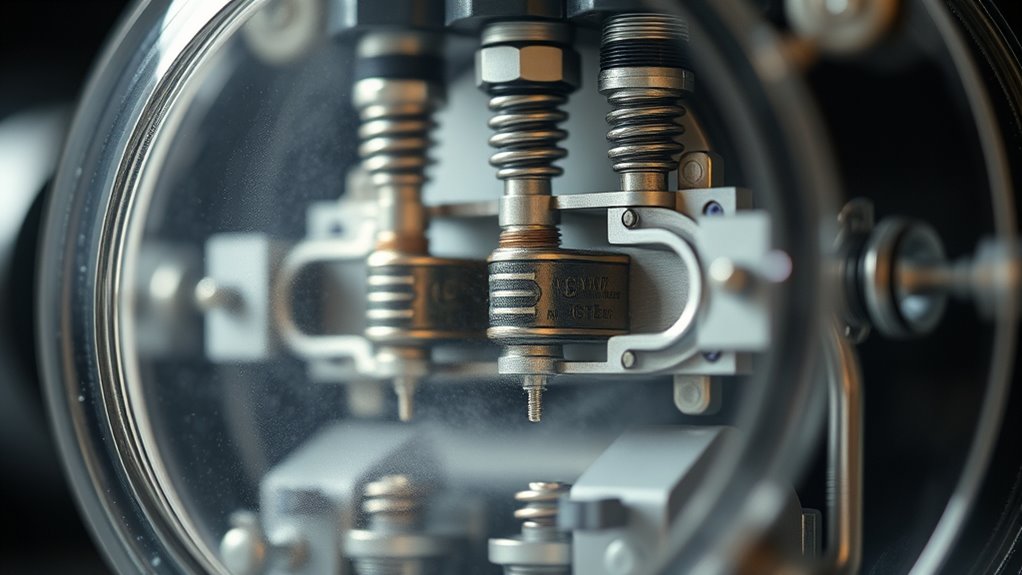
When the vacuum pressure reaches the setpoint, the diaphragm inside the switch deforms, causing a mechanical linkage to shift and trigger the internal contact mechanism. This diaphragm deformation results from the differential pressure acting within the switch.
As the mechanical linkage moves, it activates the internal contact, which either opens or closes the electrical circuit depending on the switch’s configuration. This activation sends a signal to control devices like pumps or alarms, prompting them to adjust or respond to the vacuum conditions.
The switch mechanism also includes hysteresis, meaning it won’t reactivate immediately when pressure fluctuates near the setpoint. Instead, it requires the pressure to move beyond a certain threshold, preventing rapid on-off cycling.
This thoughtful design guarantees reliable triggering only during meaningful pressure changes, maintaining system stability. Understanding what happens inside the vacuum switch when it activates clarifies how pressure changes translate into electrical responses that keep your system controlled and safe.
Frequently Asked Questions
How to Tell if a Vacuum Switch Is Bad?
You can tell if a vacuum switch is bad by noticing if it fails to activate or stays stuck in one state. Sometimes, it might show delayed switching, which can be a clear sign something’s off.
Another way to check is by testing it with a multimeter. If there’s no continuity at the set vacuum levels, then the switch is likely faulty. It’s pretty straightforward once you know what to look for!
How Does a Vacuum Switch Work?
Think of your vacuum switch as a vigilant gatekeeper. It senses pressure changes, then flips an electrical switch when a set level’s reached.
This keeps your system running smoothly without constant on-off flickers. Pretty neat, right?
How Do You Adjust a Vacuum Switch?
You adjust a vacuum switch by turning its adjustment screw clockwise to raise or counterclockwise to lower the set point. Always disconnect power first, test with a vacuum source, then reconnect and verify the new setting.
It’s pretty straightforward once you get the hang of it. Just remember to be careful when handling the switch and double-check everything before powering it back up.
Is a Vacuum Switch the Same as a Pressure Switch?
No, a vacuum switch isn’t the same as a pressure switch. You’ll find vacuum switches measure negative pressure, while pressure switches handle positive pressure.
They serve different purposes and aren’t interchangeable in your system. So, it’s important to choose the right one based on what you need.
Conclusion
Think of a vacuum switch as your system’s silent guardian, always on the lookout for pressure changes. When the vacuum dips or rises, it’s like a whisper triggering a chain reaction inside, flipping the switch just at the right moment.
You rely on this delicate dance to keep everything running smoothly, proving that even the smallest pressure shifts can spark big changes.
In understanding its steps, you discover the secret to precise control and safety. A vacuum switch works by sensing pressure differences and activating or deactivating electrical circuits accordingly. This precise control ensures systems respond quickly to vacuum changes, maintaining safety and efficiency.
So, mastering how a vacuum switch works step by step reveals how these subtle pressure variations can drive important mechanical or electrical actions, keeping your system reliable and well-protected.




One Comment